
How to Build Content Pillars That Never Run Out
One of the biggest challenges in content creation isn’t consistency.
It’s running out of ideas.
Most creators and brands don’t stop posting because they lack motivation. They stop because content starts to feel repetitive, forced, or directionless. After the initial excitement fades, the question becomes harder to answer:
“What should we post next?”
This is where content pillars come in.
When built correctly, content pillars don’t just organize content — they eliminate creative blocks, reduce burnout, and make content creation sustainable for the long term.
This blog explains what content pillars really are, why most people build them wrong, and how to create content pillars that never run out.
What Are Content Pillars (Really)?
Content pillars are core themes your content consistently revolves around.
They are not:
- individual post ideas
- trending topics
- one-time campaigns
Instead, content pillars represent the main areas of value you want to deliver to your audience.
Think of pillars as categories that can generate dozens or even hundreds of content ideas over time.
For example:
- Education
- Behind-the-scenes
- Opinions & insights
- Experiences or case studies
Each pillar supports multiple formats, angles, and depths.
Why Most Content Pillars Fail
Many people technically have content pillars — but still run out of ideas.
This usually happens because pillars are:
- too narrow
- too generic
- brand-focused instead of audience-focused
For example, a pillar like “Tips” is too vague.
A pillar like “Our Services” is too self-centered.
Strong content pillars sit at the intersection of:
- what your audience cares about
- what you can talk about consistently
- what supports your long-term positioning
Without this balance, pillars collapse quickly.
Step 1: Start With Audience Problems, Not Content Types
The biggest mistake is building pillars around formats:
- Reels
- Blogs
- Carousels
Formats change. Problems don’t.
Instead, start by identifying:
- What your audience struggles with
- What confuses them
- What decisions they’re trying to make
- What mistakes they keep repeating
For example, instead of a pillar called “Educational Content”, think in terms of:
- Common mistakes
- Misconceptions
- Beginner confusion
- Decision-making challenges
Problems create endless content. Formats just package it.
Step 2: Limit Yourself to 3–5 Pillars Only
More pillars don’t mean more ideas.
They mean less clarity.
The most effective content strategies use:
- 3 to 5 pillars maximum
This keeps your messaging:
- focused
- repeatable
- recognizable
For example:
- Education & clarity
- Process & behind-the-scenes
- Opinions & insights
- Experiences & learnings
Each pillar should feel distinct, yet connected.
If you need more than five, your pillars are likely too narrow.
Step 3: Build Sub-Angles Inside Each Pillar
This is the key to never running out of ideas.
Every pillar should contain sub-angles.
For example, under an Education pillar, sub-angles could include:
- Beginner mistakes
- Advanced insights
- Myths vs reality
- Step-by-step breakdowns
- Do’s and don’ts
One pillar × five sub-angles = endless combinations.
You’re no longer asking:
“What should I post?”
You’re choosing:
“Which pillar and which angle today?”
That removes creative pressure instantly.
Step 4: Separate Pillars From Formats
One reason creators burn out is tying pillars to formats.
Example:
- “Reels pillar”
- “Blog pillar”
This limits scalability.
Instead, a single pillar should work across:
- short videos
- blogs
- carousels
- stories
- long-form content
The idea stays the same.
Only the format changes.
This allows you to:
- repurpose content easily
- stay consistent across platforms
- reduce creation time
Pillars give direction. Formats give flexibility.
Step 5: Make Pillars Reflect Your Long-Term Identity
Ask yourself:
- What do I want to be known for?
- What should people associate with my content?
- What conversations do I want to lead?
Content pillars are not just about posting — they shape brand perception.
If your pillars are aligned with your long-term identity, content becomes reinforcing instead of random.
Over time, audiences start to recognize:
- your themes
- your voice
- your perspective
That recognition builds trust and authority.
Step 6: Allow Pillars to Evolve (Not Change Constantly)
Strong content pillars are stable, but not rigid.
They evolve as:
- your audience grows
- your expertise deepens
- platforms change
However, changing pillars too often resets progress.
Instead of replacing pillars, expand them:
- add new sub-angles
- increase depth
- adjust tone
This keeps content fresh without losing consistency.
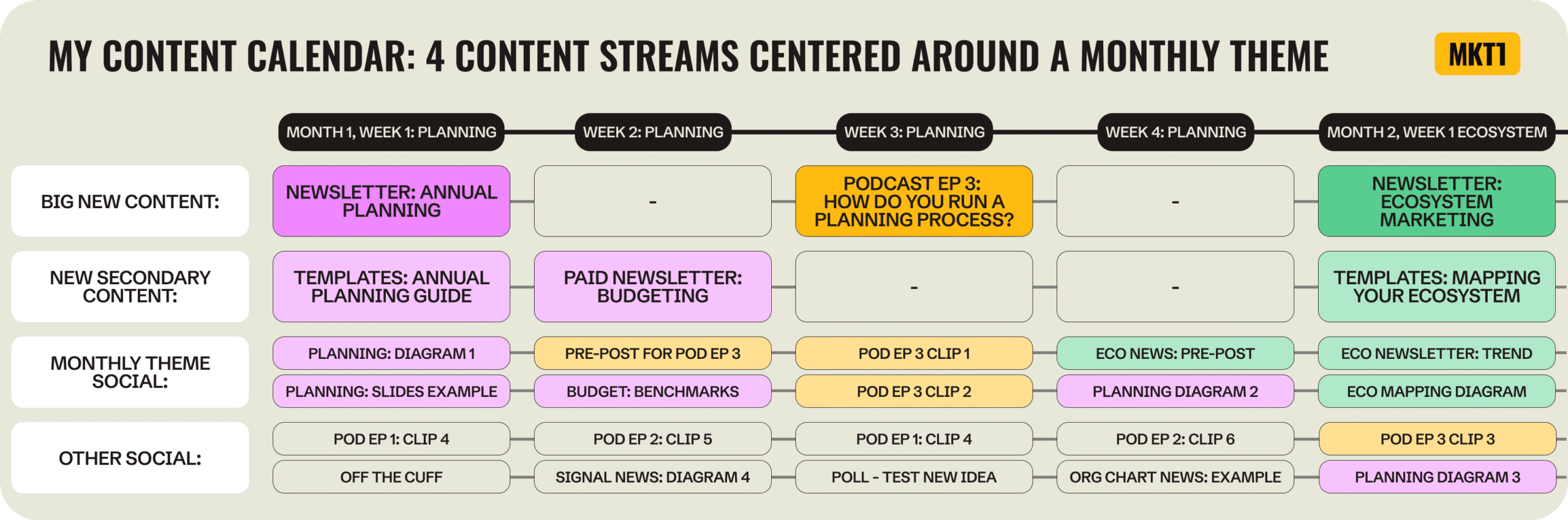
Step 7: Use Pillars to Plan in Batches
Once pillars are defined, content planning becomes easier.
Instead of planning daily, plan in batches:
- One week = one pillar focus
- One month = rotation across pillars
This reduces mental load and improves quality.
You’re no longer creating content reactively.
You’re building it intentionally.
Common Mistakes to Avoid
- Creating too many pillars
- Building pillars around trends
- Making pillars brand-centric only
- Ignoring audience problems
- Changing pillars every month
Content pillars are a system, not a checklist.
Final Thoughts
Running out of content ideas is not a creativity problem.
It’s a structure problem.
When content pillars are built around audience needs, clear themes, and flexible formats, content creation stops feeling exhausting.
You don’t need more ideas.
You need better foundations.
With strong content pillars in place, consistency becomes easier, clarity improves, and content finally starts working with you — not against you.
And when that happens, content doesn’t run out.
It compounds.